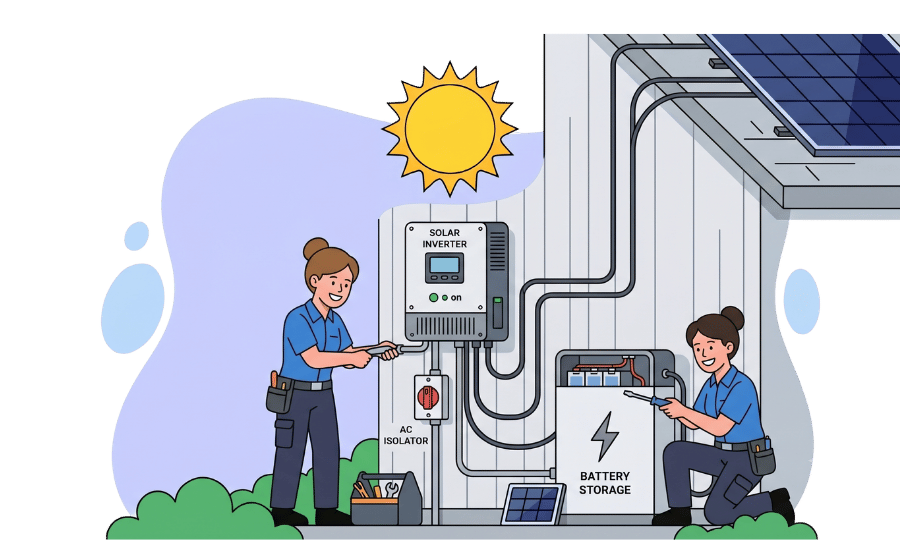
Inverters are one of the most critical components in a solar energy system. It's essentially the translator between the electricity generated by your solar panels and the electricity that powers your home. Imagine it as the brain of your solar system, and just like a brain if it turns off the body stops.
Solar panels produce direct current (DC) electricity. This type of electricity is like a battery – it flows in only one direction. However, most appliances in our homes and businesses run on alternating current (AC) electricity, which constantly changes direction. This is where the solar inverter comes in. Your inverter converts DC electricity from your panels into AC power for your home — and routes any excess to your battery or the grid.
Know your options
The type of inverter in your system affects how it handles shading, monitoring, and cost. Here’s what you need to know before getting a quote.
A single inverter connected to all your panels in a series — like a string of lights. It’s the most widely installed type in Australia due to its simplicity and low cost. Easy to install, easy to service, and the most affordable option upfront.
The key limitation is that all panels perform at the level of the weakest one. If a single panel is shaded by a tree, a chimney, or bird droppings, the entire system’s output drops — not just that one panel. Best suited to unobstructed north-facing roofs with consistent sun exposure.
A small inverter attached directly to each individual panel. Each panel operates as its own independent mini solar system, converting DC to AC right on the roof. Shade on one panel has zero effect on the others — maximum energy harvest from every panel at all times.
Microinverters also provide panel-level monitoring so you can see exactly how each individual panel is performing in real time. The trade-off is cost — expect to add $2,000–$4,000 to your overall system price compared to a string inverter setup.
A device attached to each individual panel that optimises its DC output before sending it to a central string inverter. Think of it as a microinverter’s smarter sibling — you get panel-level shade mitigation and monitoring without replacing the string inverter entirely.
Power optimisers are the go-to solution when a home has some shading but a full microinverter system isn’t in the budget. They’re more cost-effective than microinverters and significantly outperform a plain string inverter on partially shaded roofs. SolarEdge is the most well-known brand using this approach.
Not sure which type suits your roof? Our Solar Calculator will recommend the right inverter type based on your home’s layout and shading.
Independently reviewed. Click any brand to read the full review.







These types of inverters might not be built to last as long as higher-quality models and may be more prone to breakdowns
Most inverters will have some form of monitoring via app providing data on performance, energy production, and consumption.
Peak efficiency rating is normally between 94% and 98%
Warranties typically range from 3 to 10 years, with a standard warranty period being 5 years. Some manufacturers offer extended warranties for an additional cost
A project timeline is a visual representation of the project's schedule, showing the start and end dates of each task or activity.



I wasn't sure what panel brand to choose as i have really bad shading, but First Step Solar sent me to companies that had the right technology to help with my situation
Could not be anymore happier

As a singe mum i was worried i wouldn't be able to find a company that could meet my budget needs, however First Step Solar put me onto a solar company that offered a great money for value system, never looked back after getting my quotes

I am extremely impressed with the results we achieved through their digital marketing services.
Their ability to capture our brand essence and create visually stunning designs truly.

I couldn't be happier with the solution. It has exceeded my expectations and made my life so much easier.
The analytics and reporting capabilities of our software have transformed our decision-making.

Prices shown are for a 5kW–10kW inverter unit in South Australia. Your final price will vary based on:

It can vary slightly, however the majority of inverters will typically have a 5 - 10 year warranty.
While most inverters on average have an IP65 rating, installation of your inverter should generally be in an area protected by full whether as the Australian sun or storms can play their part on impacting its lifespan.
Good news, there are many inverter brands that don't have to break the bank but still perform well, have great warranties and offer the necessary safety features for Australian homes. Always consult your installer about the right product and installation location for your home.
There are 4 main things you should look for when researching a particular inverter:
- Warranty
- Efficiency
- Local support offices
- Price